How to Identify the People Who Actually Move Ideas Forward

Two questions kept coming up after in a couple conversations with product leaders. How do you align your company to get better at product discovery? And how do you find the right person to champion your project when it matters most?
I've been sitting with those questions for a while. The honest answer is that most frameworks for innovation talk about the idea, the market, the timing. Far fewer ask seriously about the person: the one who has to fight for the project in rooms you're not in, the one who decides whether something gets resources or gets shelved.
That's what this post is about.
There's a metric for this, and it's not what you'd expect
Kuratko, Morris, and Covin introduced a concept called Entrepreneurial Intensity in their book Corporate Innovation and Entrepreneurship. The premise is straightforward but easy to miss: asking whether someone is entrepreneurial is the wrong question. The right questions are how often and how intensely entrepreneurial behaviors actually show up in what they do.
EI has three dimensions: innovativeness, proactiveness, and risk-taking. Individually, each one tells you something useful. Together, they give you a real picture of whether someone will push an idea forward or let it die quietly in a backlog.
Innovativeness — but not the kind you're probably thinking of
When most people hear "innovative," they picture moonshots. New categories, industry disruptions, things that end up in case studies. That's one kind of innovativeness, but it's the least common and not always what a project needs.
The more useful distinction is between incremental and radical innovation. Incremental is small changes, refinements, improvements that build on what already exists. Radical is the discontinuous stuff: new markets, new behaviors, high risk and high reward. Both are legitimate. The question is which one your project actually requires, and whether the person you're evaluating is wired for that type.
When I'm trying to read someone's innovativeness, I pay less attention to their list of past ideas and more attention to how they respond to ambiguity. Do they get energized by it or do they reach for process? Do they protect failure as information or treat it as something to explain away? A genuinely innovative leader doesn't just generate ideas — they create an environment where others feel safe enough to generate them too.
Risk is always in the room
Every new idea carries risk. The question isn't whether to accept that, it's which risks you're actually choosing between.
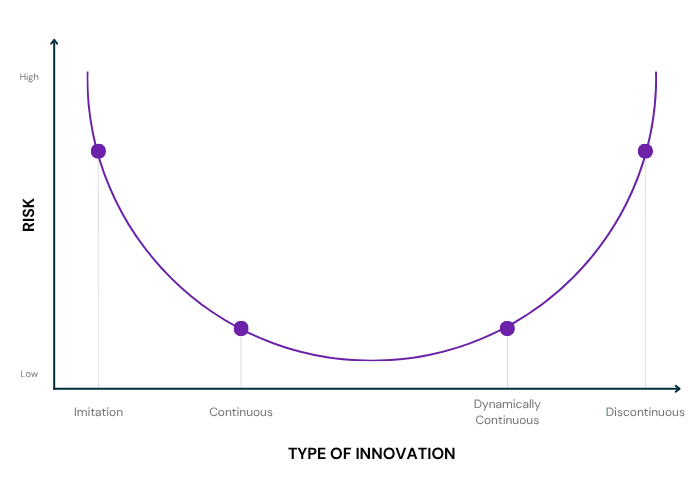
Kuratko and colleagues describe a useful taxonomy here. Imitation (copying what others have done) feels low risk but can quietly become high risk if it's the only play. Continuous innovation, the incremental kind, carries moderate risk, mostly the danger of moving too slowly and becoming complacent. Dynamically continuous innovation creates real changes in how people behave or what they expect, and the risk is mostly about timing and communication. Discontinuous innovation, the genuine breakthrough, carries the highest risk: technological, market, organizational, all of it at once.
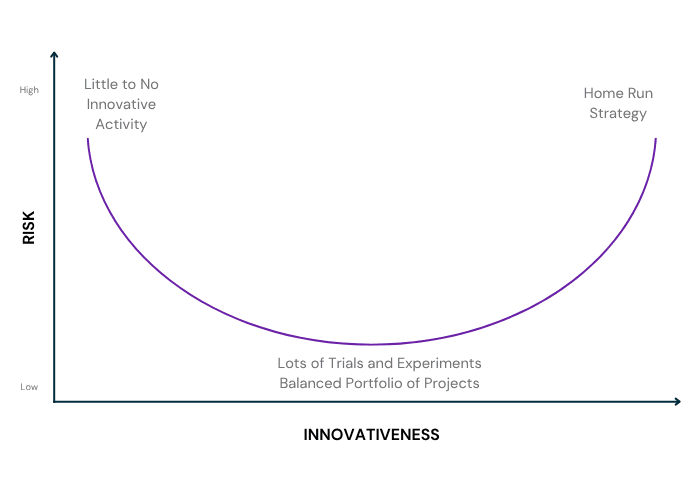
Hamel and Prahalad offer a useful reframe on how to manage this. They compare it to baseball: companies that spend all their energy perfecting their swing often lose to competitors who just take more swings. The lesson isn't to be reckless. It's that risk is better managed through frequency than through perfection.
Which brings up a tension that Dickson and Giglierano described clearly: the risk of sinking the boat versus the risk of missing the boat.
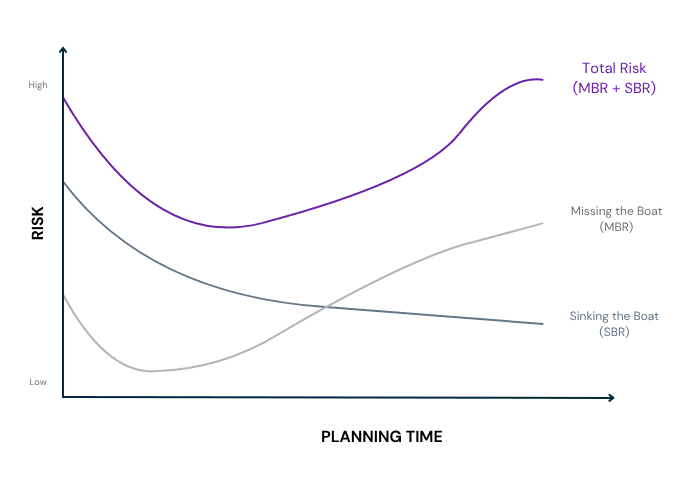
Sinking the boat is what happens when you commit too heavily to something that doesn't work: bad timing, misread market, flawed execution. Missing the boat is what happens when you wait too long, over-analyze, and watch a competitor move first. These two risks don't behave independently. Early in an innovation process, sinking the boat is the dominant concern. As time passes, missing the boat becomes the bigger threat. The window closes. The market moves. What felt like caution starts to look like hesitation.
The manager you want understands this tension intuitively. They don't wait for certainty because they know certainty is often just "missed the boat" wearing a different name.
Proactiveness — the dimension people underestimate
Of the three dimensions, proactiveness is the one that's hardest to assess from the outside and most predictive of whether an idea actually goes anywhere.
Kuratko references the Nike slogan deliberately: just do it. Proactiveness is action over reaction. It's the difference between a manager who identifies a problem and one who builds a coalition, navigates the organization, and comes back three months later with something implemented.
There's a story in the book about an engineer who designed a better truck bed for transporting equipment, genuinely useful, clearly valuable. But the innovation wasn't the design. The innovation was everything that came after: selling it to management, finding the right advocates, adapting when he hit resistance. That's proactiveness. The idea was the starting point, not the achievement.
Proactive people don't wait for permission to move. But the best ones also know that adaptation isn't weakness. Research consistently shows that high proactiveness combined with strategic flexibility outperforms high proactiveness alone.
Putting it together: the entrepreneurial grid
EI as a concept becomes most useful when you stop treating the three dimensions separately and start looking at how they combine, and at what frequency.
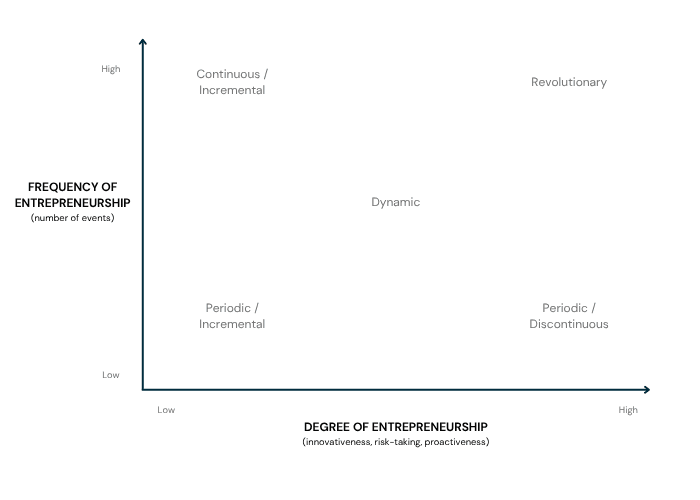
Kuratko, Morris, and Covin introduce the entrepreneurial grid for exactly this reason. The grid maps degree (how innovative, risky, and proactive someone's actions are) against frequency (how often those behaviors actually occur). The result is a profile, not a score.
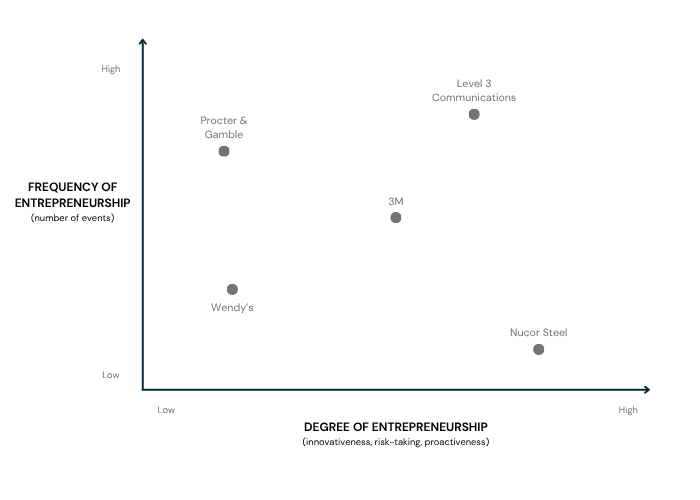
A manager might score high on degree, pursuing bold, risky, genuinely innovative moves, but do it rarely. That profile fits certain roles and certain projects. Another manager might score lower on degree but act entrepreneurially all the time, constantly pushing incremental improvements and low-stakes experiments. That profile fits differently.
Neither is better in the abstract. The question is fit: fit to the project, fit to the moment, fit to what the idea actually needs from a champion right now.
Procter & Gamble has historically fit the high-frequency, moderate-degree quadrant: constant incremental innovation across a huge portfolio. Nucor, the steel company, operates differently, with fewer, more radical bets. Bill Gates built Microsoft with dynamic, high-degree innovation. Ray Kroc built McDonald's with relentless operational proactiveness, adapting an existing model and scaling it with discipline. All four are entrepreneurial. They're just entrepreneurial differently.
How to actually find the right champion
This is the part people want most from the framework, and the honest answer is that there's no clean shortcut. But the dimensions give you better questions to ask.
Start with EI. Which of the three dimensions does this project actually need most right now? An early-stage concept in a resistant organization probably needs proactiveness above all: someone who can move things without being asked. A project that requires convincing a skeptical market might need innovativeness, the capacity to reframe and adapt. A project with real technical or commercial uncertainty needs someone who has genuinely made peace with risk, not someone who says they have.
Then use the grid to calibrate for frequency. Do you need someone who swings often, even if each swing is modest? Or do you need someone who takes bigger, less frequent bets and has the stomach for the wait?
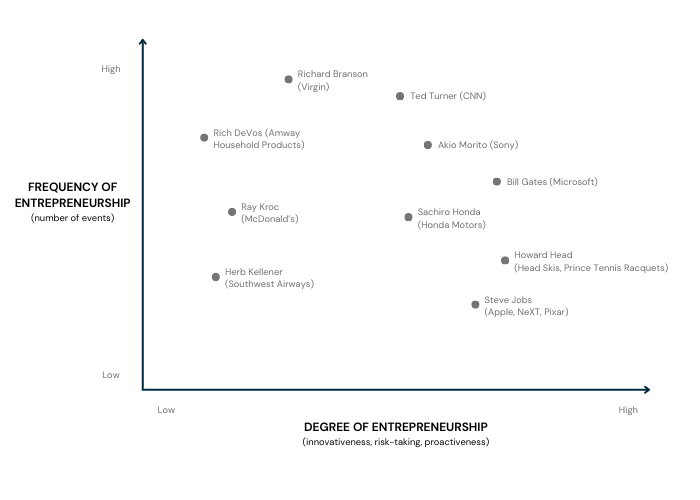
Map the candidates against those questions, not against their title or their reputation for being "entrepreneurial." Once you've identified the right person, the support structure matters as much as the selection: real autonomy, access to cross-functional teams, a clear mandate from leadership, and enough cover to fail fast without it becoming a career event.
Then pay attention. The entrepreneurial grid isn't static. Projects evolve, needs shift, and the champion who was right for the first six months might not be right for the next phase. That's not failure. It's just how complex projects work.
The CRISP approach to product discovery is built around questions like these: not just what the idea is, but who needs to carry it, and whether the environment will let them. Most innovation stalls not because the idea was wrong, but because the wrong person was holding it in the wrong organization at the wrong moment.
Getting that alignment right is, in my experience, harder than getting the idea right.
And worth every bit of the effort it takes.
Rafael J. Schwartz
Product leader. Writing about teams, clarity, and building things that matter.
Keep reading


Let’s talk
If something here resonated, if you're working through a product problem, or if you just want to think out loud — reach out!