Mondly Workplace English
I defined Pearson’s Workplace English strategy in 14 days, driving 22% higher engagement by bridging the "Confidence Gap" with a lean, one-developer team...
My first two weeks at Pearson were not an onboarding. They were a deadline.
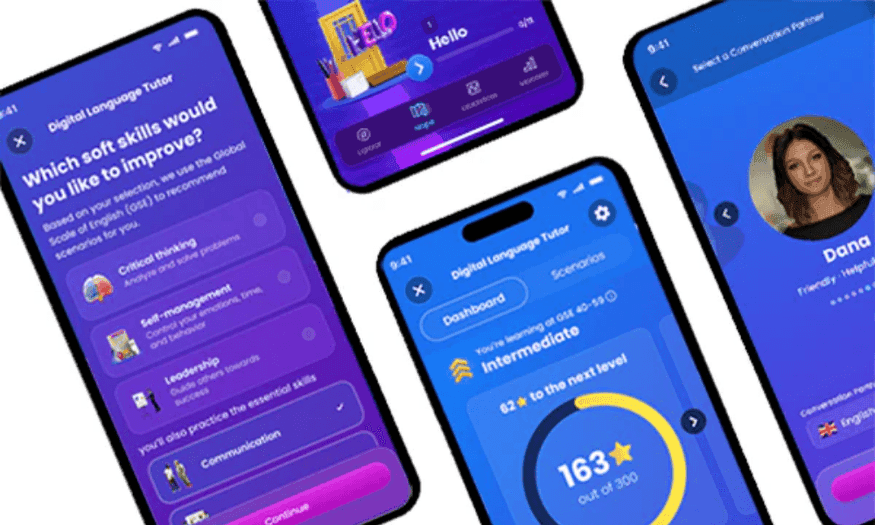
I'd joined right as Pearson was still figuring out what to do with Mondly — a consumer language app with 100 million downloads that they'd just acquired and were trying to point at the corporate market. There was no Workplace English product. There was a B2B dashboard inherited from MondlyWORKS, a sales team struggling to explain what they were actually selling, and a pile of research waiting to be read.
Two weeks in, I had to present a strategy.
What the research actually said
The existing research pointed in an interesting direction, but it took commissioning new work — quantitative and qualitative — to sharpen the picture into something actionable.
The finding that changed everything: non-native English speakers in corporate environments were consistently perceived as having lower proficiency than their test scores actually showed. The gap wasn't in their grammar. It wasn't in their vocabulary. It was in their confidence — specifically, their confidence applying what they knew in professional situations. Meetings. Presentations. Negotiations. The moments where it counts.
Pearson's own research put a number on it: roughly half of English learners leave formal education without confidence in their speaking skills. That's not a small rounding error. That's the majority of people who've technically learned the language walking into the workplace feeling like they haven't.
This was the insight I brought into that two-week strategy session. And it became the product.
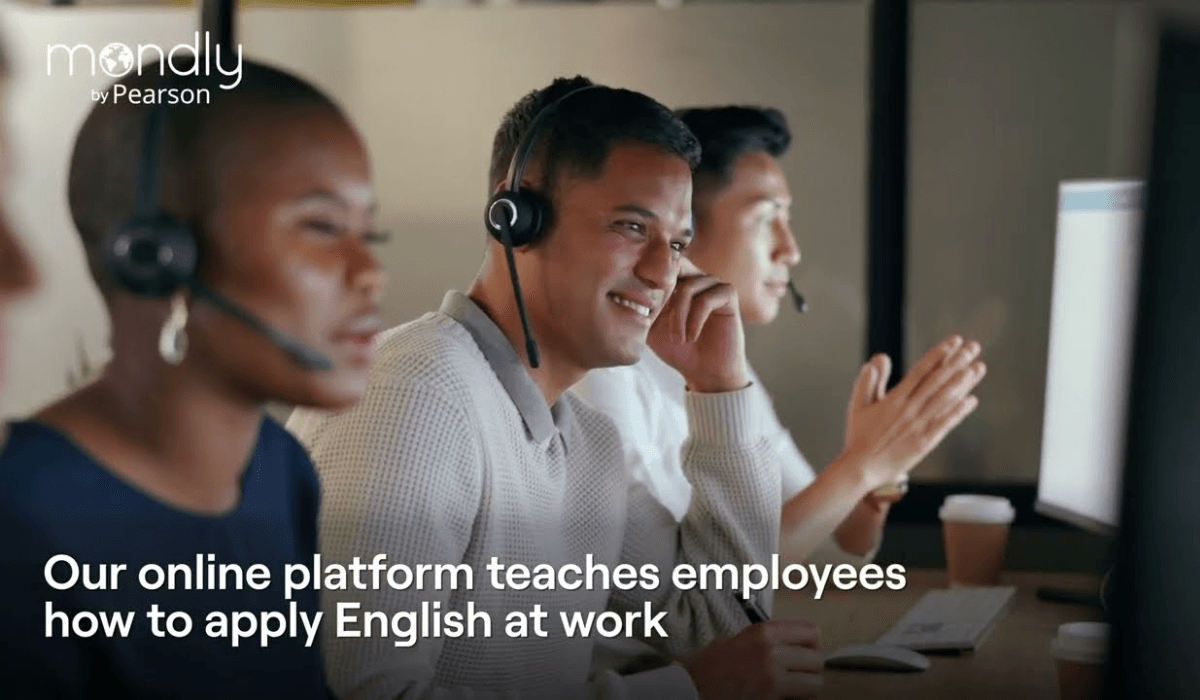
If the problem was confidence in professional application, the solution wasn't more grammar exercises. It was building something that placed learners inside workplace situations — real ones, with real soft skills woven in — and let them practice until the application felt natural, not just the language itself.
That's where Workplace English came to life.
What we actually built
The product structure was straightforward in concept, harder in execution. Learners would see a set of topics at their proficiency level — something like SMART goals, or handling a difficult conversation with a client. Each topic was a lesson that taught both the language and the underlying professional skill simultaneously. What are SMART goals and why do they matter? Now use that vocabulary in context. Now answer questions that require you to actually think through the soft skill, not just recite definitions.
The content came from Pearson's existing library — traditional long-form courseware that we broke into micro-learning modules designed for mobile. Video was central to this, which was a meaningful step beyond the flashcard-and-quiz format that dominated consumer language apps. Depth of learning through video versus a Duolingo-style card flip: it's not a small difference when you're trying to build the kind of confidence that transfers to a real meeting room.
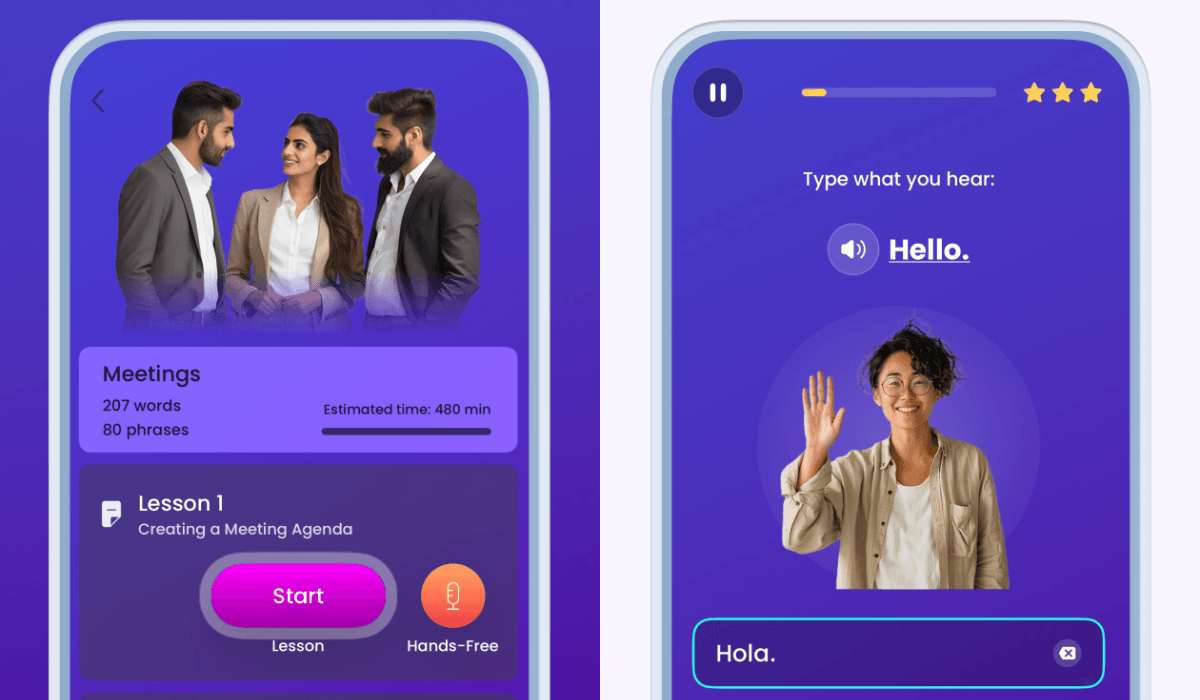
The soft skills layer was also the market gap. It's rare for a language learning product to teach both language and professional skills in the same experience. That combination was what gave us a differentiated position against other corporate language tools — and it was what made the sales team's job easier once they understood it. They finally had an answer to "why not just buy Duolingo Business."
Building with nothing
Here's the part that doesn't show up in the product description.
I had one developer. No dedicated design resource. The B2B dashboard I'd inherited needed to be rebuilt fast enough to support the new features we were shipping.
So I became the designer. Not because that was the plan, but because the work needed to happen and there was nobody else to do it. The approach we settled on — the approach we had to settle on — was pragmatic: move quickly, run experiments, measure what happened, learn, and iterate. Build the psychological safety for the team to fail fast rather than wait for perfect.
It was not the most resourced product environment I've worked in. But something about the constraint made the decisions cleaner. You can't gold-plate anything when you have one developer. You decide what matters and you ship it.
The dashboard work ended up improving satisfaction scores by 15%. The Workplace English content itself drove engagement up 22% and measurably improved learning outcomes compared to the previous baseline. Those numbers came from a combination of things — the video format, the micro-learning structure, the soft skills integration — and it's hard to isolate any single cause. What I can say is that the research-to-product loop worked: we identified a real gap, built something directly aimed at closing it, and measured the result.
What it became
Workplace English shipped. It became part of Pearson's enterprise offering — what they now call Mondly by Pearson for Business — structured across three tiers and deployed in environments ranging from Istanbul airport to Expo 2025 in Osaka. The confidence gap insight I'd used to position the product internally eventually made it into Pearson's broader market materials and pedagogical framework.
The product I helped bring to life in fourteen months is now part of an enterprise suite that Pearson's ELL division — which grew revenue 30% in 2023 — continues to build on.
What I took from Mondly wasn't the product metrics. It was the reminder that good product work often happens in conditions that don't make it easy. One developer. No design support. Two weeks to define a strategy. Political environments that make shipping anything feel like an achievement in itself.
Sometimes the most important skill is knowing what to protect when everything around you is trying to slow you down.
Rafael J. Schwartz
Product leader. Writing about teams, clarity, and building things that matter.
More work
Let’s talk
If something here resonated, if you're working through a product problem, or if you just want to think out loud — reach out!